
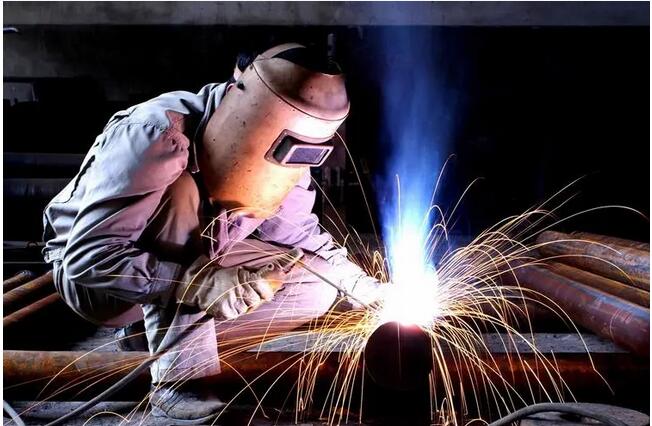
Stainless steel welding is more complicated than carbon steel welding.
First, stainless steel effectively retains heat causing it to warp when exposed to the high temperatures that welding creates. Stainless steel can also warp or crack during the cooling process after it has been heated by a welder. Even when a piece of stainless steel doesn’t crack or warp after a bad welding session, it will nearly always show scratches and blemishes.
Each kind of stainless steel presents a distinct challenge to welders. Austenitic steel may crack if given a high heat input or if you make a concave or flat weld. Martensitic steel can crack if not properly preheated. And with its low maximum interpass temperature of 300, ferritic steel will lose strength unless it’s heated with a low heat input.
The key to successfully welding stainless steel lies in getting the right filler material. The filler material grade needs to match the base material’s grade to get a good weld.
Why Is Welding Stainless Steel So Difficult?
Welding stainless steel can be pretty challenging for several reasons:
Stainless steel has a much higher thermal conductivity than other metals, which requires more heat input to weld correctly. This makes it more difficult to control the welding process and can cause distortion and warping of the material.
Stainless steel contains chromium, which can react with the carbon in the welding electrode and form chromium carbides. This process can cause the stainless steel to become brittle and susceptible to cracking, which can be challenging to detect and prevent.
Stainless steel is more prone to corrosion than other metals, so any welds must be adequately cleaned and protected to avoid pollution or contamination.
The high cost of stainless steel means that mistakes or rework can be costly and time-consuming.
In summary, welding stainless steel requires a high level of skill, experience, and attention to detail to ensure a successful and high-quality weld.
Various Challenges of Welding Stainless Steel
Welding stainless steel poses various challenges that can make it a complex material to work with. One of the primary challenges is its high thermal conductivity, which makes it harder to control the heat input during the welding process.
This can cause distortion, warping, and other issues with the material, ultimately affecting the quality of the weld. Another challenge is the formation of chromium carbides, which can occur during welding when the metal reacts with the carbon in the welding electrode.
These carbides can make the stainless steel brittle and cause it to crack or fail under stress. To avoid this, special welding techniques and filler metals must be used, which require a high level of expertise and skill.
Additionally, stainless steel’s susceptibility to corrosion means adequately cleaning and protecting the weld area is critical to avoid contamination and pollution. Other challenges include:
The high cost of the material.
The need for specialized welding equipment and techniques.
The requirement for strict quality control standards is to ensure that the final product meets the necessary specifications.
In summary, the various challenges of welding stainless steel require a skilled and experienced welder to achieve a high-quality weld that meets the stringent requirements of the application.
Related News

What Is Stainless Steel?
Like other steels, stainless steel is an alloy of iron and carbon. What makes stainless steel different, though, is its inclusion of at least 10.5% chromium, an element that makes the resulting alloy c

Iron vs Steel What is the difference?
Steel and iron are two of the most common materials used in the manufacturing industry. They are used to make a wide range of products and components. While iron and steel look similar, though, they ar
Differences Between 316 and 316L stainless steel
316 stainless steel has more carbon in it than 316L. This is easy to remember, as the L stands for "low." But even though it has less carbon, 316L is very similar to 316 in almost every way. Cost is ve

Related Comments